1. Select a discrete app icon.








notes

When preparing to leave an abusive partner, survivors are often encouraged to create a safety plan. This document is a proactive blueprint of the steps a survivor will take to leave an abuser—the where, when and how of it all. It’s a place to organize thoughts and make a list of evidence the survivor has to help make their case in court. It’s a list of what they need to remember to pack should they flee their home in a hurry. It’s also an outline of any possible scenarios that a survivor may encounter when leaving and a possible plan of action for each.
There’s a second kind of safety plan that’s less often talked about but may be just as helpful to survivors during and after abuse: an emotional safety plan. This plan considers the feelings that may arise as you start to contemplate leaving an abuser or after you’ve already left. Even when your partner is abusive or controlling, you can still feel love or commitment toward them. There can be feelings of self-blame and sadness that the relationship didn’t work out. When you share children with the abuser, you can feel immense guilt at times that you’re “breaking apart the family” even though your partner’s abuse was the reason the family broke apart in the first place.
Below you’ll find an emotional safety plan that you can download, print and fill in with your own details. These steps can apply both when you’re still with an abusive partner as well as after you leave. However, if you’re still with an abuser, take caution and keep this print-out in a safe place where the abuser won’t find it, such as your place of work or a friend or family member’s house.
Emotional safety means feeling accepted as your authentic self. It means you don’t feel like you’re walking on eggshells when you’re around someone. You can be vulnerable, open and honest about how you feel. You’re not always expecting another person to explode if you say the wrong thing. For many survivors, the exact opposite of this was true for the entirety of their relationship with an abuser. Some survivors report that unrelenting psychological attacks were more damaging than physical beatings.
After you leave an abuser, you need to find a place where you can find emotional safety. This may be:
Write down who your emotional safety person or people could be here:
________________________________________________________________________
“Some people are still very much in love with their abusive partner,” says Maria Garay-Serratos, former CEO of Sojourner Center, a domestic violence shelter in Phoenix, Ariz. “Finding their strength and worth apart from their partner is an ongoing process.”
Much of this can be attributed to something called trauma bonding, a powerful psychological attachment abusers exploit by making survivors believe there is hope for their future, that the violence is not the abuser’s fault and that they can change. Signs of trauma bonding include the survivor focusing on the “good” in the person, despite behaviors you know are abuse, thinking you can change an abuser, and feeling like you can’t trust them to stop being abusive but you are not able to leave them.
When children are involved, it can get even more complicated. The desire for an intact family can be a powerful obstacle to leaving and staying apart from an abusive partner.
“A lot of people stay in relationships because they don’t want to separate the other parent from the children,” Garay-Serratos says.
If kids talk about missing the other parent, it can make feelings of guilt and regret even stronger. But just as the parent who leaves an abusive partner can grapple with mixed feelings, so can the children. Peer support groups can help families see those mixed feelings as normal, while reinforcing the value of a safe environment.
The next step here is to educate yourself on how trauma can manifest and the ways your brain may be processing it.
__ Educate yourself on different types of domestic violence as well as tactics abusers use, some of which may have been used against you.
__ Read more about trauma bonding and how it’s not rooted in actual love for a person.
__ Learn about triggers that can send you back into a state of panic or anxiety. This can help you prepare better to deal with them when they arise.
__ Explore the articles on this site about how trauma can show up in children and how to help them process that trauma. Understanding these behaviors can help you see them as part of your child’s healing process—not a reflection of your parenting.
You may find yourself replaying decisions or wondering what you could have done differently. These thoughts are common—but they’re often rooted in the ways abuse distorts responsibility. Practicing self-compassion means recognizing that you made the best decisions you could with the information, resources and safety available to you at the time.
When you start hearing that critical voice in your head, think of what you’d say to a friend who was saying the same thing. Use those words on yourself.
For instance, instead of “I should have seen the red flags earlier,” say, “I didn’t know how abusers could escalate and I had hope things would get better.”
Instead of, “It’s my fault that my children and I stayed as long as we did,” say, “I was doing the best I could in a difficult and unsafe situation. Leaving at any other time could have put us in even more danger.”
What’s a phrase you keep hearing that you need to replace with something more compassionate?
Critical self-speak: _____________________________________________________
Self-compassionate replacement: ___________________________________________________
This step applies whether you’re still with the abuser or have already left, although some abusers can make this difficult by using sleep deprivation as a tactic of control. You deserve rest, even if that hasn’t always been possible.
Scientists say that sleep reenergizes our body’s cells, helps regulate our mood, creates more white blood cells to defend against illness and helps us to heal from injuries. But how can we get the recommended seven to nine hours when our brains stay on high alert during and after trauma? Create a new bedtime routine. This could include journaling (aka, brain dumping any stressors that threaten to keep you awake), listening to soft music, taking a warm bath, making a soothing cup of tea and turning on a sound machine (the Calm app is great for this—who can’t fall asleep to the soothing sound of ocean waves?). Create your new bedtime plan here.
The physical and emotional aftereffects of abuse can take a toll on a person’s ability to make a plan and put it into action. “If someone has a traumatic brain injury [TBI] or post-traumatic stress disorder [PTSD], it’s hard to develop an emotional safety plan if they haven’t dealt with these first,” says Maria Garay-Serratos, former CEO of Sojourner Center, a domestic violence shelter in Phoenix, Ariz.
People affected by trauma may wonder what’s wrong with them when they experience difficulty processing information and making plans, Garay-Serratos says. But impaired decision-making can be a symptom of these traumatic conditions. Victims of strangulation and suffocation are at risk for TBI, even if they never lost consciousness.
Screening for TBI or PTSD can guide survivors toward the medical and psychological care they need to function more effectively. Talk to a medical professional about being screened for a TBI or PTSD or addressing any other physical or mental trauma symptoms you weren’t able to seek help for while with an abusive partner. Many abusers withhold medical care and medication as a form of control.
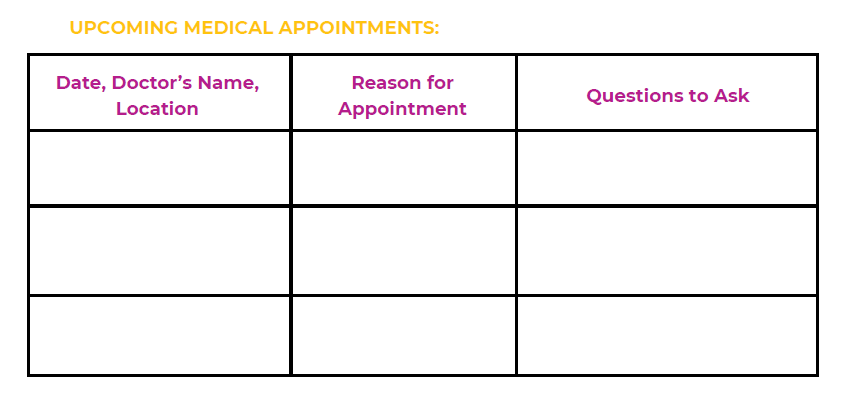
Keep track of your medical appointments here:
Abuse often shrinks your world. Reconnecting with safe people can help expand it again. To maintain control, many abusers isolate their partner from family and friends. After leaving, a survivor may feel alone. All survivors’ journeys are different—you may relish this sense of independence, or your new solo journey may mean you start to feel emotionally unstable. If needed, this is the time to ask for support.
Try making a list of people you lost touch with during your relationship with the abuser. Think about old friends, family members, coworkers, faith leaders, teachers or mentors. You may not reach or reconnect with everyone on your list, but you may be surprised at the people who can help—or the number of people who can relate to what you’re going through, for better or worse. Think of each connection as a way to rebuild a web of support.
People I May Want to Reconnect With, When I’m Ready
You don’t have to reach out to anyone on this list. This is just a space to notice who comes to mind.
Trauma can feel like carrying around a backpack full of bricks. These heavy, emotional bricks can include sadness, regret, guilt, anger, anxiety and many others. Over time, the goal is to set those bricks down. There’s no one “right” way to process what you’ve been through, so over time, consider trying some different methods and seeing if they make that load you’re carrying feel any lighter.
This emotional safety plan isn’t something you have to complete all at once. You can return to it, revise it or set it aside when you need to. Healing doesn’t follow a straight line, and neither does this process.
To find support in understanding abuse and its aftermath, visit our Get Help page to locate a domestic violence organization near you with advocates ready to listen. Or use Hope Chat, our AI assistant located at the bottom of your screen. Hope Chat can help lead you to articles on our site that explain abusive tactics and safety solutions in more detail as well as connect with a domestic violence advocate who can help.
Your support gives hope and help to victims of domestic violence every day.

Welcome, this is your discreet connection to help.
You are safe here.
Menstruation is an experience shared by
generations of women across the globe.
Sadly, abuse is another commonly shared experience between women.
Be it physical or psychological, abuse is not OK in any form.
Period.
You are not alone.
Help is just a few clicks away.
Welcome to DomesticShelters.org, a trusted Bright Sky US partner. On DomesticShelters.org, you will find free domestic violence resources such as:
The Bright Sky US website is still open on your browser in a separate tab, so you can return to the Bright Sky US website anytime.


