1. Select a discrete app icon.








notes

Disclaimer: This content is provided for informational purposes only and is not intended as legal advice. Every case is unique, and readers should consult with a qualified attorney for guidance specific to their situation.
Many survivors enter family court with legal representation, only to find themselves navigating the system alone at some point or another. Becoming a pro se litigant (i.e., one who argues their own case in court without an attorney) is challenging under any circumstances. When you are also a survivor of domestic violence or coercive control, the difficulty is compounded.
You may be managing ongoing trauma responses while simultaneously participating in a legal process that mirrors the dynamics of abuse you experienced during your relationship. For many survivors, family court becomes a space where abuse continues—only now, it may come through a different channel: the abuser’s attorneys.
In some cases, the attorney representing your abusive partner may behave in ways that feel aggressive, demeaning or intentionally provocative. This can include mischaracterizing facts, using inflammatory language or sending communications that appear designed to create pressure or elicit a reaction.
While not always the case, it is important to recognize that litigation can be a channel for manipulation. In “high-conflict cases” (cases that involve coercive control and power/control dynamics), communication may be used strategically—not to clarify issues, but to provoke responses that can later be used to portray you negatively.
Where the abuser can perpetuate abuse, the money continues to flow to the attorney. These interactions can create what feels like repeated “setups,” where the goal is to draw out a reaction that shifts attention away from the underlying concerns and onto your response. For survivors, this dynamic can be particularly difficult because it resembles earlier patterns of being provoked, discredited or reframed. This is often referred to as abuse by proxy—where another person (i.e., the attorney) perpetuates harm on behalf of the abuser.
When this occurs, the focus of the case can subtly shift—from examining harmful behavior to scrutinizing the protective parent’s reactions. Recognizing this pattern allows you to step back, avoid engaging in unproductive exchanges and instead respond in a way that is measured, factual, and aligned with the record you want the court to see.
If a communication feels triggering, inflammatory or misrepresentative, pause and assess it through a strategic lens.
Ask yourself:
Is this designed to provoke a reaction?
Is this creating confusion or distorting facts?
Is this shifting focus away from the actual issues?
Labeling the behavior internally as strategic provocation or misrepresentation can help reduce its emotional impact and allow you to respond more effectively.
Every written communication you send may one day appear in front of a judge. That reality can feel intimidating, especially when you are managing trauma responses. If you have sent something in frustration, you are not alone.
Instead of dwelling on past communications:
What matters most is consistency moving forward. Thoughtful, measured communication over time carries weight. If an exhibit is placed before you in court, acknowledge your response for what it was—a trauma response. Then, apologize and move on. You cannot go back in time, but you can change your responses moving forward, which demonstrates to the court that you are focused on your recovery.
While communication with an abusive ex may call for a “gray rock” approach (minimal, neutral responses), communication with opposing counsel is different. When false statements or accusations are made, it is important to correct the record clearly and calmly.
For example:
“Counsel, I am in receipt of your email dated [X]. I am providing documentation in accordance with the court’s orders. Your client is required to provide access to the medical benefits portal when seeking reimbursement for medical expenses. To date, that access has not been provided. I am not authorized to issue payment until I am able to independently verify the expenses. Upon compliance with the orders, I will ensure prompt payment.”
This approach:
If an accusation escalates—for example, claims of medical abuse—you can reframe:
“I am acting in accordance with my parental responsibilities to seek appropriate medical care for our child.”
You are not arguing—you are documenting.
A helpful strategy is to write every email as though the judge is copied. This can help guide tone, clarity and professionalism.
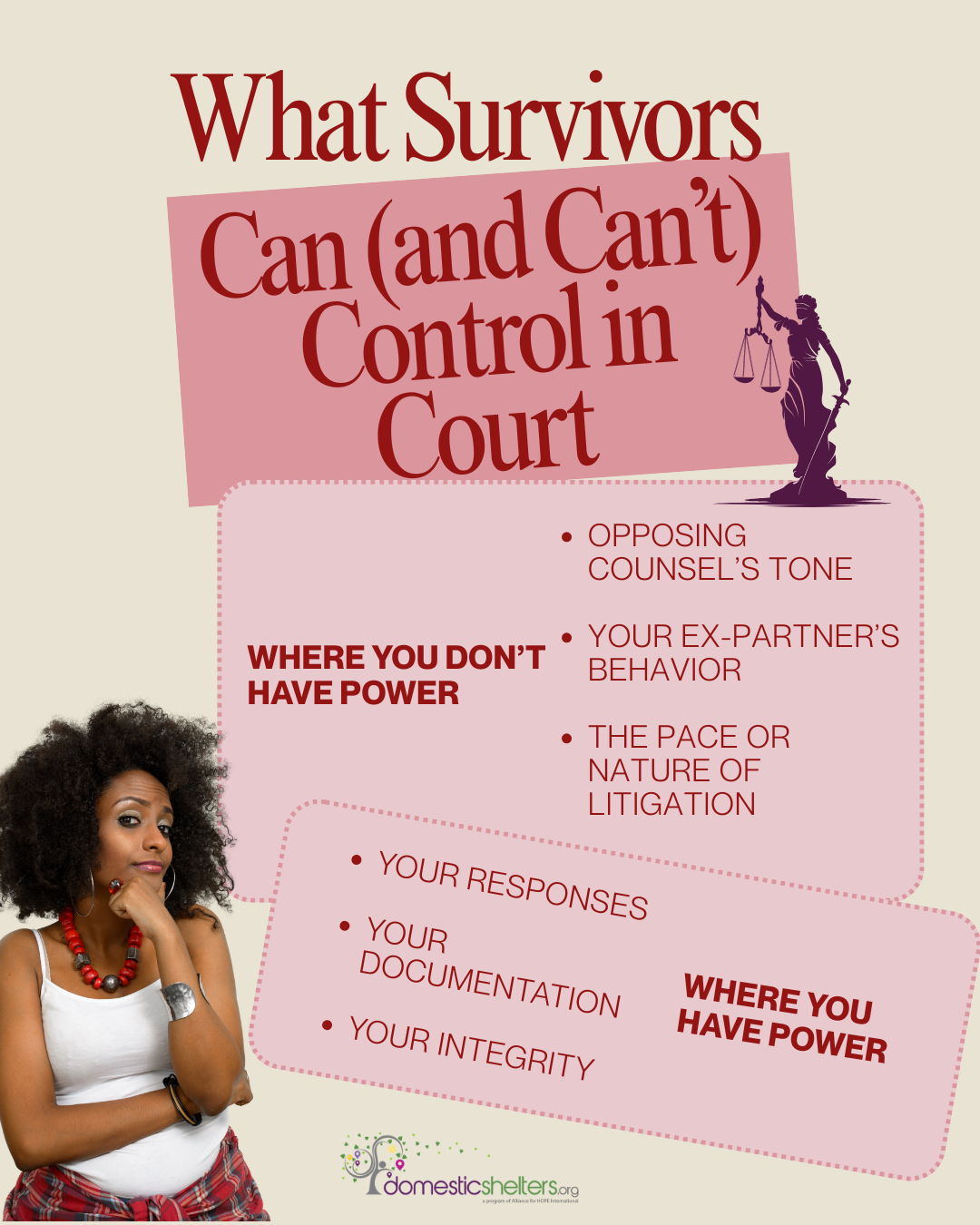
Family court often operates within conflict. When parties are cooperative and compliant, the need for litigation typically decreases.
In high-conflict cases, however, communication and legal action may not always be directed toward resolution. Ongoing conflict can extend the life of a case and shift focus away from underlying issues.
Recognizing this can help you break reactive patterns and remain grounded in a more strategic, long-term approach.
You do not control:
You do control:
Compartmentalizing the behavior of others (i.e., seeing it as part of the process rather than a reflection of your worth) can help protect you from additional emotional harm.
Threats of contempt, sanctions or legal consequences can feel overwhelming. Abusers often use them to create fear and urgency.
While you should always take legal risks seriously, it is important to maintain perspective:
If you are…
…you are building a record that supports you.
At the same time, it is important to recognize that courts do not always respond consistently to violations—on either side. Focusing your energy on what you can control—your children’s well-being and your own stability—often yields the greatest long-term benefit.
Instead of reacting to every accusation or distortion, consider sending a structured, fact-based communication periodically (for example, quarterly). This can serve as a clear record of ongoing issues.
Keep it brief, factual and organized.
For example:
Sample language:
“I am prepared to reimburse medical expenses upon receipt of access to the medical benefits portal, as required by the court’s orders. Permanent orders outlining these requirements were issued a year ago. Thus far, I have not received access to the portal.”
“I am willing to contribute to extracurricular expenses when decisions are made in accordance with the requirement to confer prior to enrollment. Thus far, your client has made unilateral decisions without conferring.”
This type of communication creates a clean, professional record without escalating conflict.
You are not required to respond immediately—especially to hostile or harassing emails. When possible: pause, step away and return when you are regulated. And remember, not every message requires a response. Some are better preserved as documentation.
If communications escalate to the level of harassment and begin to impact your well-being, consider:
If behavior escalates beyond litigation into stalking or safety concerns, prioritize your safety and consider contacting law enforcement.
Navigating family court as a pro se survivor requires more than legal awareness—it requires emotional resilience, strategic thinking, and self-compassion.
You may not be able to control how others behave within the system. However, by grounding your communication in clarity, documentation and professionalism, you create a record that reflects truth, consistency and credibility. Most judicial officers are looking for parents who can prioritize their children and engage in effective co-parenting to the extent possible.
By focusing your efforts on reducing conflict and clearly documenting the record, you can begin to shift out of a place of fear and toward one of stability and recovery. In doing so, you not only support your children’s well-being, you also protect your own peace in the process.
If this feels familiar, you don’t have to navigate it alone. Visit our Get Help page to connect with a local organization, or use HopeChat at the bottom of your screen to speak with an advocate who can help guide you through next steps, including support with legal proceedings.
Your support gives hope and help to victims of domestic violence every day.

Welcome, this is your discreet connection to help.
You are safe here.
Menstruation is an experience shared by
generations of women across the globe.
Sadly, abuse is another commonly shared experience between women.
Be it physical or psychological, abuse is not OK in any form.
Period.
You are not alone.
Help is just a few clicks away.
Welcome to DomesticShelters.org, a trusted Bright Sky US partner. On DomesticShelters.org, you will find free domestic violence resources such as:
The Bright Sky US website is still open on your browser in a separate tab, so you can return to the Bright Sky US website anytime.


