1. Select a discrete app icon.








notes

Andrew Tate wants to sell a promise to men, specifically young men. For just $99 a month, one can access the influencer’s secrets of “modern wealth creation” on a platform called The Real World. A life of excess—multiple cars, houses and women—is possible using his blueprint of hustling, investing in cryptocurrency, “looksmaxxing” (creating a body that will impress women) and starting your own coaching grift, err, platform, like his.
Tate, we should mention, is also accused of rape and sex trafficking minors. He was banned by Twitter, when it was still called that, for saying that women bear responsibility for being sexually assaulted. (He was allowed back on X.) Multiple women have accused Tate of rape and strangulation, with one victim sharing a text message from Tate with BBC where he wrote “I love raping you.”
This mix of aspirational self-improvement, misogyny and alleged abuse is packaged as lifestyle advice and marketed directly to adolescents. But it isn’t Tate’s con alone. He’s part of a broader online ecosystem known as the manosphere. And while Tate is one of the most visible figures in the manosphere, he’s far from the only one—and arguably not the most important. For young men who log onto any social media platform, their identifying details of age and gender automatically funnel them into a consistent flow of similar toxicity that, at first, feels like encouragement at an age when boys often feel the most self-conscious.
The shift to a toxic ideology of hating women for not revering men’s efforts to wow them is subtle. Soon, peppered into the YouTube videos and TikToks on weightlifting and how to get more protein comes an undercurrent of entitlement. The message is that women owe men for all this effort, and men are allowed to take what they’re owed. The idea that rape should be legalized suddenly doesn’t sound that radical once men are brainwashed into believing they’ve been slighted this whole time and how the feminist movement has taken away their value by promoting the idea that women don’t need men.
One subculture of the manosphere is the idea of “looksmaxxing,” or striving to be as attractive as possible (at least in a man’s own mind) by adhering to a strict set of physical standards. It most often affects the younger sect of men and boys on the manosphere, and is rooted in societal pressure to fit a stereotype of masculinity. What may first appear as a social media influencer promoting health and fitness—going to the gym regularly, eating a strict diet focused on muscle-building—it soon escalates into a fixation on achieving “ideal” features framed as objective markers of worth. Influencers and online communities dissect facial symmetry, jawlines and body composition, sometimes assigning their attractiveness a number. Illegal steroid use or cosmetic surgery is often promoted, sometimes referred to as “hardmaxxing.”
Advocates and researchers say these belief systems don’t exist in a vacuum. The idea of toxic masculinity—narrowing masculine traits into only the ones that promote traditional gender roles, lack of emotion, aggression and dominance—unsurprisingly shapes how some men approach relationships and how they respond when that control is challenged.
“Men may respond to the threat to their masculinity with violence. They carry the reminder that they are the head of the household, they are the one in charge, and that they hold the most power. They may assert that power through violence,” says Aylin Kaya, a researcher with the University of Maryland who focuses on gender studies.
“Toxic masculinity hurts both men and women,” Kaya says. Men who are encouraged to behave in the ways outlined above may have a lingering sense that something isn’t right, and research shows that men who adhere to the traits of toxic masculinity are at risk for anxiety, depression, substance abuse and suicide.
Joanna Schroeder, former executive editor of The Good Men Project, co-authored the book Talk to Your Boys: 16 Conversations to Help Tweens and Teens Grow into Confident, Caring Young Men along with educator Christopher Pepper. She says boys who absorb toxic masculinity messages often struggle to form healthy relationships, distancing themselves from intimate relationships with women. They may internalize the idea that vulnerability is a weakness. But as they grow older—and as the prefrontal cortex, responsible for decision-making and impulse control, continues developing into their mid-20s—that can shift.
“When they meet a woman they respect, it could be the first time they have any kind of emotional intimacy. Often, we see extreme clinginess and dependence. They feel it’s the appropriate thing to do, to have control. It’s all based in fear of losing the person you feel safe with,” says Schroeder.
Dominating a partner and limiting their freedom through abusive tactics like intimidation, stalking, threats and physical violence is called coercive control. This type of abuse may start subtly but can escalate over time, trapping a survivor in a relationship with a partner who may put their safety—even their life—at risk.
The flip side of this ideology shows up in a subset of boys and men who identify as “incels,” or involuntary celibates. These boys and men often frame their lack of romantic or sexual relationships as the result of women’s superficiality or cruelty. The result is a deep resentment and anger toward women, denigrating them online by suggesting they are not human and calling them “femoids.”
Their worldview doesn’t just express anger; it also justifies it. Some self-described incels have celebrated or been linked to acts of mass violence, including the 2014 killings in Isla Vista, Calif., by 22-year-old Elliot Rodger, where he explicitly framed his attack as punishment for women who rejected him through a YouTube video confession and a 137-page manifesto.
In March, Netflix released documentarian Louis Theroux’s deep dive into this disturbing online consortium. Inside the Manosphere highlights Tate’s counterparts—or maybe protégés—HS TikkyTokky (real name Harrison Sullivan) and Sneako (real name Nicolas Kenn De Balinthazy), ages 24 and 28, among others. In a mix of dark humor and something closer to terror, Theroux pulls back the curtain of how these men rake in steady paychecks by convincing other men to emulate them, all while talking about their “body count” and flaunting bikini-clad women who drift through rented mansions like set decorations.
The idea isn’t just that men should wield power over women—though that’s central in some of the manosphere’s most visible corners. A recurring message is that women can’t be trusted. So while certain influencers promote strategies to “get” women, they also encourage boys and men to keep them at arm’s length.
As one manosphere subject, Myron Gaines (real name Amrou Fudl), tells Theroux, he practices one-sided monogamy with his girlfriend. “I do what the f*ck I want to do. She’s loyal to me. It’s monogamous on her end, open on my end. She packs my f*cking condoms when I travel, that’s how real it is.”
This kind of shock-content is widely accessible, and young boys are a key audience. Rhetoric like Gaines’ doesn’t stay confined to podcasts or streams—it follows boys home, onto their phones, into their bedrooms, and, increasingly, into the way they talk about girls, relationships and power.
Jamie, a 50-year-old Pennsylvania mother of a 13-year-old son and a 16-year-old daughter, has had more reason than most to think carefully about what her kids absorb online. A survivor of sexual assault, she says she’s always tried to be proactive about the messages they receive about relationships, power and respect—but learning about the manosphere raised the stakes.
Her son, she says, is already aware of it. When he mentioned adding protein powder to smoothies—something he’d seen online—she felt a flicker of concern. Over protein powder.
Knowing what she did, she wondered, who is this influencer? Where does this go next?
His response was immediate: “Oh my god, Mom, I’m not stupid.”
She laughs. “I feel very lucky.” He understands that tipping point, she says—that clean eating and gym content promoted by male influencers with a significant following has the possibility of sliding into something much different—and darker.
“We’ve talked about it a lot.”
That, she says, is the part many parents underestimate: how quickly seemingly harmless content can shift.
“You may think it’s innocuous,” she says. “But there is content beyond your imagination.”
Her advice to other parents is simple, but urgent: stay engaged, even if you think you already understand what your child is seeing.
“I’m online all the time,” she says. “But what gets fed to me is very different from what gets fed to my kid. You get this false sense of I’ve seen it all. But you haven’t.”
Other parents are bracing for that moment, trying to understand the messages their sons may soon encounter.
“I think our society is set up for all of us to be lonely, and then boys find someone who tells them they’re a victim,” says Kimberly Jo Burke, 37. The Tucson mom of a 9-year-old son and a 2-year-old daughter says she watched Theroux’s documentary with her husband in preparation for what their son may be exposed to.
“I have a degree in education and my husband has a degree in history. We’re trying to constantly educate ourselves, knowing our son is going into pre-teen age.” Burke has talked to her son about feminism in the past and “what women have gone through,” but the documentary revealed a gap in those conversations.
“I’m going to educate him on what these men are doing. They operate like a cult and they’re specifically targeting these young boys for their time, money and attention.”
She says that today’s society is a hierarchy, and there are boys and men who feel like they’re at the bottom, reinforcing their victim mindset, their frustration hardening into anger.
“Men above [them] are telling them, ‘You’re going to be a boss; you’re going to have these nice cars,’ and they don’t. But the only emotion they’re allowed to show is anger. Showing emotions makes them weak. They’re not taught how to be men—they’re taught how not to be women.”
“We are all in the manosphere—it’s up to us how we get out,” says Theroux at the end of his documentary.
The influence of the manosphere is hard to avoid. Its messages reach boys and men across platforms, often disguised as self-improvement or success advice. A teenage boy might be drawn in by promises of confidence, wealth and status—content that frames becoming an “alpha male” as the goal. What’s often missing, or downplayed, is the accompanying message: that women are to blame when men don’t achieve it, and that disrespect or hostility toward them is justified.
To a parent or teacher, the early signs can look harmless—even positive. A new interest in fitness, discipline or ambition can read as healthy development. But in some cases, those messages are part of a deeper funnel into more extreme, misogynistic beliefs.
Even the most engaged, equality-minded parents may find themselves asking: how did my child get here?
Schroeder has a theory.
“We talked about girl power and [the] ‘future is female’ type of campaigns, which are essential, but we left boys hanging.”
She says what was often missing was a clearer explanation of what a more feminist society actually looks like—that the goal was equality, not the omission or discounting of men.
“It left a gap in their understanding,” she says, explaining that exploitative men online are now spreading the message of, “‘You know, they’re trying to get rid of you. They want women to be powerful over you,’ instead of explaining that women want to have more economic and political power.”
“It’s an immature point of view, yes, but we’re talking about kids, and they’re immature by definition.”
So how do you keep your kids out of the manosphere? You can’t entirely—and that’s the point. It will find them, whether through social media, peers or the broader culture. The goal isn’t total avoidance, but preparation: starting conversations early, naming the messages they may encounter and helping them recognize manipulation before it takes hold.
In the mid-1990s, tobacco executives told Congress they didn’t believe nicotine was addictive. Internal documents later showed they knew the opposite was true—addiction was the business model.
There’s a similar dynamic in parts of the manosphere. Many influencers present themselves as mentors for young men—offering advice on confidence, dating and success—but their business model often depends on keeping followers hooked: on content, on outrage, and, eventually, on paid courses, subscriptions or platforms.
At one point, Theroux tests HS TikkyTokky’s financial platform himself, investing $500 with the promise of big returns. Within a month, the money had all but disappeared. While HS claims a multi-million-dollar net worth, outside investigations have shown he likely has much less to his name.
“Adolescents and young adults are wired for justice and fairness. They don’t want to be taken advantage of,” says Schroeder.
Helping kids recognize that disconnect—between the image being sold and the reality underneath—can be instrumental in keeping them from going down the rabbit hole. When teens start to see the pitch for what it is, they may be less likely to buy into the broader worldview that comes with it.
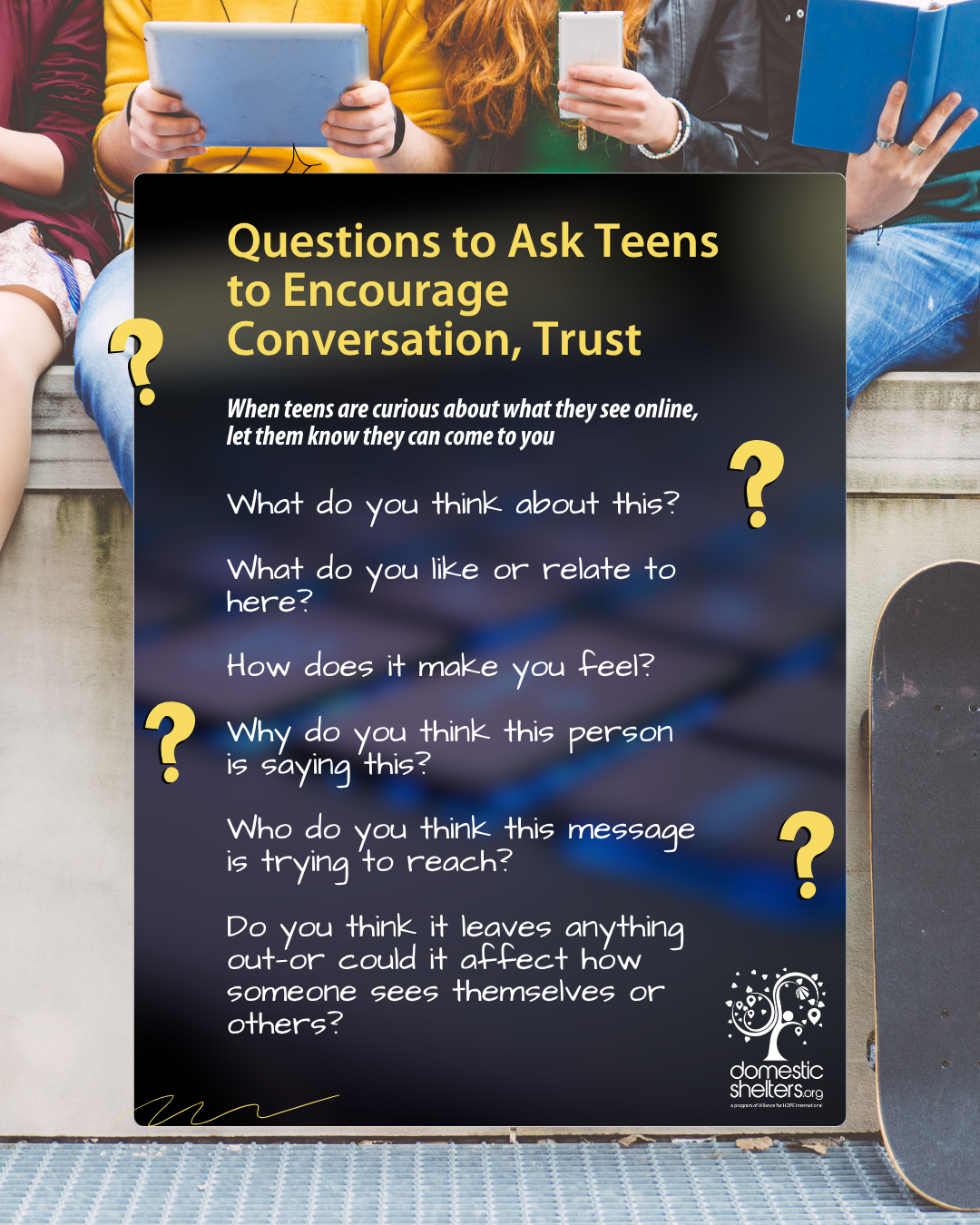
Sure, as parents, we may want to immediately remove any electronic devices from our kids at the first sign that they’re being targeted by conmen and hateful brainwashing. Maybe it’s a fix, but they’re likely going to internalize that it’s not OK to share with you the confusing messages or questionable people they encounter online.
“Make sure your kids know they can show you anything and you won’t take their device away,” says Schroeder. Build trust by opening a dialogue with kids.
What do you think about this?
What do you like or relate to here?
How does it make you feel?
Why do you think this person is saying this?
Who do you think this message is trying to reach?
Do you think it leaves anything out or could it affect how someone sees themselves or others?
While boys and girls alike are warned plenty about what not to do in relationships, sometimes what’s lacking is more information about the opposite side. Talking about what healthy relationships should look like, sound like and feel like may better help them see the discrepancy in influencers’ content encouraging power and control, as well as rigid gender roles.
In “A Guide to Healthy Relationships,” the components of what make up a fair relationship are outlined. They include the following—though parents should tailor the list based on their child’s age.
Trust. Do you feel like your partner is being open and honest with you and not keeping secrets? Does this person trust you to have friendships and family relationships without jealousy or suspicion?
Respect. Does your partner respect your boundaries, listen to you when you say no to something, and not sulk, get angry or guilt-trip you as a result? Does your partner respect your opinion on things even if it differs from theirs without degrading or putting you down?
Communication. Can you talk to your partner about your feelings without fear of judgment or backlash?
Dependability. Do you feel like you can rely on your partner to be there for you when you need them? Do they show up at the place they say they’re going to be at the time they said they’d be there?
Happiness. It may sound obvious, but do you feel happier after spending time with this person and not drained? Does this person raise and not lower your self-esteem?
Patience. Does your partner let things in the relationship evolve at a comfortable pace rather than rushing you to get serious quickly or move in together or get married right away?
Space. Does your partner allow you to have personal space when needed without following you, calling or texting you relentlessly or making you feel guilty for doing something without them.
Kindness. Is your partner kind, even if you’re in a disagreement? Do they show remorse if they say something they regret? (Yes, there is a healthy way to argue.) Also, is your partner kind to others—your friends, family members, people in the service industry?
Honesty. Do you trust that your partner is being truthful? Do they speak honestly about their past, any previous relationships and own up to their part in past break-ups?
Growth. Is your partner willing to evolve the relationship and themselves as time goes on, to change and adapt as life changes occur (children, health issues, a move)?
Comfortable Intimacy. Do you feel safe talking to your partner about your intimacy boundaries, things you like and don’t like, even if those things change over time? Is your partner comfortable talking about sexual safety and protection?
Equality. Do you feel like an equal to your partner? Do you feel like your roles in the relationship are not defined by your gender identity?
Schroeder says she was surprised to learn from her sons that, within a locker room setting at school or sports, the talk is much more harmful than you think. Gay, racist, sexist and antisemitic insults and slurs are experimented with, and other boys laugh, some unaware of what exactly they’re laughing at and others afraid of being singled out if they don’t. She gives the example of overhearing jokes about being gay. “So, maybe nobody in your locker room is out as a gay kid, but I want you to imagine that your friend is gay, and he’s keeping that secret. But then you guys are saying these anti-gay things in the locker room. How might he feel?” She says to pause here and let your child consider it. “And if he says, ‘I don’t know,’ you model how empathy works.
“I imagine the message he’s getting is that it’s not OK to be who he is,” she says, as an example. From there, she says to delve into how this kind of talk might affect his self-esteem.
Even the most well-intentioned “talks” don’t always resonate with teens. Fiction, though, can open a different door. The novels below explore online life, social isolation and the search for belonging—along with the risks that can come with it. They could be helpful for adolescents of any gender and parents—if you read them along with your teen, it could open up a dialogue naturally.
Aristotle and Dante Discover the Secrets of the Universe
If you’re concerned about how these dynamics may be showing up in your child’s life—or in your own relationships—you don’t have to navigate it alone. Visit our Get Help page to find a domestic violence organization near you, where trained advocates are available to listen and support you. You can also use Hope Chat, our AI assistant at the bottom of your screen, to explore articles on abusive tactics, healthy relationships and safety strategies.
Your support gives hope and help to victims of domestic violence every day.

Welcome, this is your discreet connection to help.
You are safe here.
Menstruation is an experience shared by
generations of women across the globe.
Sadly, abuse is another commonly shared experience between women.
Be it physical or psychological, abuse is not OK in any form.
Period.
You are not alone.
Help is just a few clicks away.
Welcome to DomesticShelters.org, a trusted Bright Sky US partner. On DomesticShelters.org, you will find free domestic violence resources such as:
The Bright Sky US website is still open on your browser in a separate tab, so you can return to the Bright Sky US website anytime.