1. Select a discrete app icon.








notes
Co-authored with David Adams, Ed.D. Founder of EmergeDV program for domestic violence offenders.
Survivors of coercive control domestic violence often recount “arguments” or “fights” that last hours or days. As Beth describes it:
"Billy would back me into our bedroom, yelling in my face. He’d curse. He’d tell me that I ruined his life and that I’m a terrible wife and mother. He’d say that everything was my fault and that he was sorry he met me. I’d be sobbing. Whimpering. Shrinking. Trying to explain. In the end, I’d agree with whatever he said and apologize. I’d do anything to make these fights end. But they could go on for hours, sometimes all night. And then I’d have to work the next day. I believed him, that it was all my fault. I just remember trying to not die. When the baby was born, I asked my mom to move in to take him during Billy’s tirades."
These verbal assaults establish abusers’ “ownership” and damage targets’ confidence. Abusers feel more powerful by making their targets feel powerless. Verbal abuse sessions are more than just insults or common bickering. They are one-way, extreme, and frequent or prolonged. The targets are isolated from people who otherwise might help them feel better about themselves.
Domestic abusers often display an “out of control” temper. This is a tactic—abusers “lose their temper” when it seems like a good strategy. At other times, they can pose as the picture of calm rationality in the face of their partners’ “dysregulation.” Stark (2022) has called this kind of behavior “losing control to gain control.”
Maggie’s father, Will, described his son-in-law:
"He was always raging at her about money. She’d have to account for every penny. Meanwhile, he bought himself an expensive car, a truck, and a boat that he never used. He’d treat his friends to dinners and drinks. And then he’d tear into her for hours about how it was her fault that the kids had to wear second-hand clothes."
Domestic abusers often claim that they were angered by something their partner did or said. But a particular issue doesn't set them off. Rather, they become “enraged that the victim/survivor has responded in a way that they perceive as resistance to their control” (Katz, 2022, p. 20). They are trying to snuff out all resistance. So, abusers pick an issue to get angry about. Abusers call these events “fights” or “arguments.” But these terms inaccurately imply that both people are amping up the conflict. “Psychological torture” is a more accurate term; it clearly identifies that one person holds the power.
Psychological torture has been defined broadly as, “the intentional infliction of suffering without resorting to direct physical violence" (Hong & Pickering, 2023). Long sessions of verbal abuse are intended to enforce the target’s submission. The attacks could be about sex, chores, children, money, or anything, really. These sessions usually include being backed into a corner, a room, or a wall. The abusers effectively trap their victims. One victim-survivor described being “Mentally beat down over and over again.”
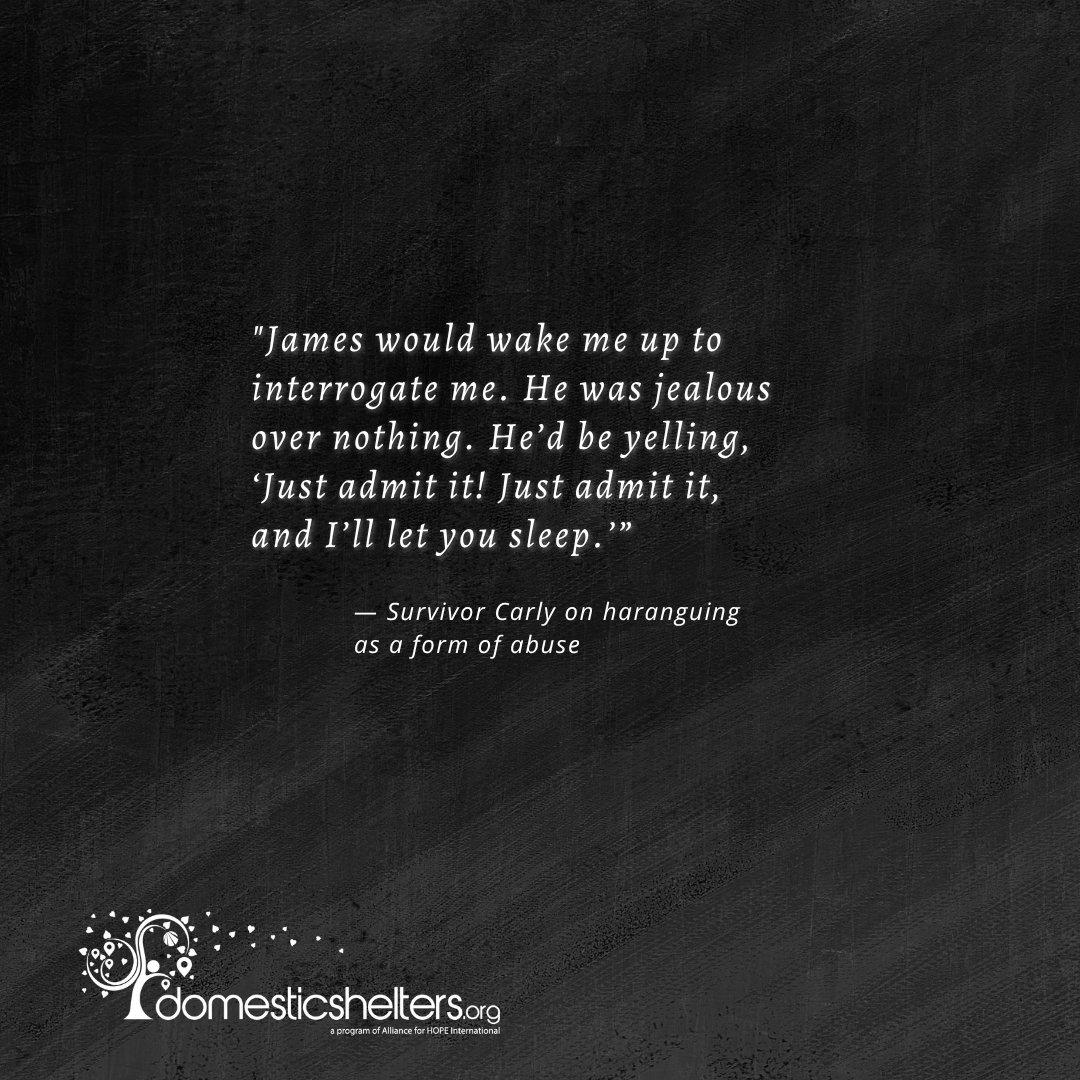
Abusers often harangue their partners to get “a confession.” Carly said:
"James would wake me up to interrogate me. He was jealous over nothing. He’d be yelling, 'Just admit it! Just admit it, and I’ll let you sleep.' He’d be pacing around, throwing things. I’d be afraid he’d wake the kids. He’d be yelling that I was a whore and a slut. I’d end up apologizing just to get him to quiet down. But once he got started, there was no stopping him. At work, I’d be a wreck with puffy eyes from crying all night and not sleeping."
Over time, Carly recognized that James’ rage attacks caused her to lose most of her friends and miss out on a promotion at work.
Hinda described the verbal abuse session in her marriage:
"He’d hold my face, making me keep eye contact. He’d decided that I’d done something 'wrong,' like see my family or talk to my friends. He’d decided I was lying but just wanted me to admit it. He’d ask tons of questions and wouldn’t stop. For hours. Then he’d say, “Are you sure? Are you sure? I can tell you’re lying, because you’re nervous.” It didn’t matter whether I was telling the truth, he wouldn’t let up until I admitted I was lying. Sometimes I’d say I was lying when I wasn’t, just to make him stop. But then there were times I did lie because I had wanted a bit of freedom. Maybe I had done something that he didn't like but which wasn't really wrong, like buy myself a little treat."
Domestic abusers often define “love” and “commitment” in ways that constrain their victims. They may demand that they move in together, get married, get pregnant, or share sexual photos. They may demand that their partner prove their commitment by turning over money or property. If the target hesitates or refuses, they may harangue them until they give in.
Sometimes, haranguing takes the form of badgering for sex. This might include prolonged nagging, begging, and complaining. It might include jealous accusations and threats of infidelity or rape. The abuser may alternate sulking and silence with displays of rage. As Tanya said,
"He’d interrupt my workday and wake me up at all hours of the night for sex. If I said 'no,' he’d stomp and bang around before returning and demanding sex again. Or he’d launch into a tirade that could last until the next morning. If I still refused, he’d either just do it anyway or give me the silent treatment. He’d barely talk for days, even at the dinner table."
Victims of verbal abuse sessions often learn to dissociate to get through. Verne describes freezing:
"When we were fighting, he wouldn’t let me go to the bathroom. I had to wait until he was done with his rant. I mostly just sat there for hours, afraid. He’d demand that I talk. Nothing I’d say during those arguments was good enough. I’d freeze up. Just freeze. Space out."
People who endure long sessions of verbal abuse will sometimes yell back, throw things, and even push their partner or grab a knife. Unfortunately, survivors can get into trouble for these responses (Larance, 2024), especially if they are being recorded.
Abusers often claim they “lost control,” were “worked up,” or that they “just wanted to get to the bottom of it.” Most of the time, they blame their victims. But these verbal attacks are purposeful. They cause victims to submit in the moment and into the future. They crush the targets’ will to assert themselves and raise their own complaints.
We need to recognize haranguing as a tactic of intimate partner abuse. Mental health professionals need to avoid mistakenly thinking that these “fights” can be solved through improving intimacy or communication. One partner holds the key to ending these encounters. The other is doing everything possible to de-escalate the situation.
Your support gives hope and help to victims of domestic violence every day.

Welcome, this is your discreet connection to help.
You are safe here.
Menstruation is an experience shared by
generations of women across the globe.
Sadly, abuse is another commonly shared experience between women.
Be it physical or psychological, abuse is not OK in any form.
Period.
You are not alone.
Help is just a few clicks away.
Welcome to DomesticShelters.org, a trusted Bright Sky US partner. On DomesticShelters.org, you will find free domestic violence resources such as:
The Bright Sky US website is still open on your browser in a separate tab, so you can return to the Bright Sky US website anytime.


