1. Select a discrete app icon.








notes

When you’re in the middle of a custody case—especially one involving abuse—it’s common to hear that a custody evaluation is the next step. It’s often presented as a neutral, even helpful, process that will ‘get to the truth’ and help the court make the best decision for your children.
But for many survivors, it can feel less like a choice and more like something you’re expected to agree to. The fact that custody evaluators exist does not necessarily mean this option is right for you or your case.
Before moving forward, it’s worth slowing down and taking a closer look at what a custody evaluation actually is, how it functions and what it can mean in practice.
Custody evaluators are sometimes called “parental responsibilities evaluators,” “child and family investigators” or “guardian ad litem” (GAL). While this individual has significant influence over the process, they may or may not have the proper training to understand domestic violence and coercive control, or to interpret evidence or testimony of the survivor properly.
This means the same individual is responsible for gathering information, conducting interviews, reviewing records, consulting outside sources and ultimately making recommendations that shape the outcome of your case. If they didn’t receive sufficient training, their findings may not be grounded in a research-based or safety-informed framework. Nevertheless, judges in most jurisdictions rely heavily on these recommendations when making decisions about parenting time and decision-making authority.
The level of influence custody evaluators have raises an important question: What safeguards ensure that the process fully accounts for the realities of domestic violence and coercive control?
In theory, custody evaluations are meant to support the court’s obligation to act in the best interests of the child. In practice, however, the process depends heavily on the evaluator’s training, experience and interpretation of complex family dynamics. Not all evaluators have the same depth of understanding when it comes to abuse—particularly coercive control, which often operates in subtle and non-physical ways.
Without specialized training, behaviors rooted in abuse may be misinterpreted as “high conflict,” mutual dysfunction or communication issues between parents. That distinction matters. When abuse is not properly identified, the resulting recommendations may not fully address safety concerns for either the survivor or the children.
There is a structural difference between custody evaluations and courtroom proceedings that many people do not realize until they are already in the process.
In court, rules are in place to keep things fair, ensuring that evidence is reliable and properly vetted. Due process also gives each side the right to confront that evidence by questioning it directly and cross-examining witnesses.
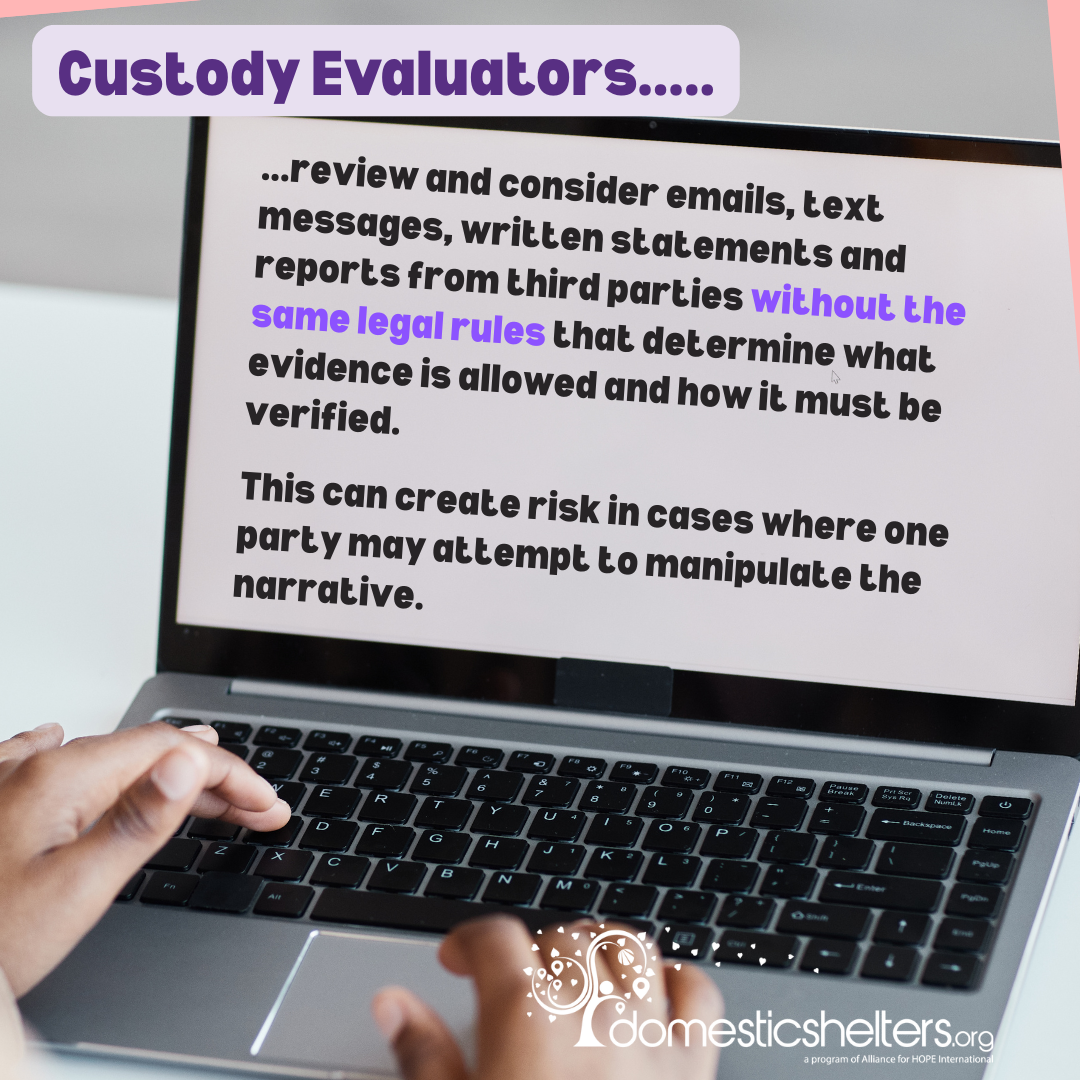
Custody evaluations operate much differently. Evaluators often review and consider a wide range of materials—emails, text messages, written statements and reports from third parties—without the same legal rules that determine what evidence is allowed and how it must be verified. While this flexibility is intended to give evaluators a fuller picture, it can also create risk, particularly in cases where one party may attempt to manipulate or control the narrative.
In today’s digital landscape, the risk isn’t just theoretical; it’s especially high in cases involving coercive control and domestic violence. Communications can be edited, deleted or fabricated by abusers, especially using artificial intelligence. Messages can be taken out of context or presented selectively. There have been cases of abusers manipulating evidence or using artificial intelligence to interpret their own evidence or that of the survivor’s to portray the survivor in a negative light. In some cases, survivors encounter situations in which information submitted to the evaluator does not accurately reflect reality, yet it still becomes part of the overall assessment.
Another layer of complexity can come from collateral contacts that are often included in the evaluation. Evaluators frequently speak with family members, friends and professionals who have interacted with the parties. These individuals may provide valuable insight, but they are not neutral fact finders, and their perspectives may be shaped by incomplete or biased information.
Unlike in a courtroom, survivors typically do not have the opportunity to cross-examine these individuals or meaningfully challenge their statements. For many, this can feel like a significant departure from the principles of fairness and due process that are otherwise central to legal proceedings.
Mental health professionals may also be included as collateral sources. While many therapists and counselors are highly skilled, not all are trained to recognize the dynamics of domestic violence or coercive control, particularly when those dynamics are present within the context of a relationship that has been labeled as “high conflict.” Without that lens, patterns of abuse may be misunderstood, and those misunderstandings can influence how an evaluator interprets the case.
Psychological testing is another component that often carries weight in evaluations. Tools such as the MMPI (Minnesota Multiphasic Personality Inventory) are commonly used, yet they were not originally designed to assess parenting capacity.
When interpreted without careful attention to trauma and context, results may be misunderstood or overemphasized. Survivors who are navigating the effects of abuse may present in ways that reflect stress, anxiety, or hypervigilance—responses that are entirely consistent with their experiences, but that can be mischaracterized if not properly contextualized.
There are also important practical considerations to understand before agreeing to the evaluation process. Custody evaluations are often lengthy, sometimes taking months to complete, and they can be financially significant. Costs can vary widely, ranging from several thousand dollars to substantially more depending on the scope of the evaluation. For many families, this represents a considerable time and resource investment. There is substantial research showing that evaluations and family court proceedings often bankrupt survivors and families. If you cannot afford an evaluation, this is something to consider.
Beyond the financial impact, the process itself can be emotionally taxing. For survivors, it may create additional opportunities for ongoing interaction—direct or indirect—with an abusive partner. It can also provide a platform where the dynamics of control and narrative-shaping continue to play out in new ways. Many individuals enter the process without fully anticipating how demanding it will be.
None of this means that custody evaluations should be avoided completely. In some cases, they can provide valuable insight and assist courts in making informed decisions. But they are not without limitations, and they are not always as neutral or straightforward as they are often presented.
From a legal perspective, it is important to recognize that custody evaluations function as a form of delegated decision-making within the broader judicial process. While the court retains ultimate authority, the evaluator can significantly influence the outcome. That makes it critical for survivors and their attorneys to approach the decision thoughtfully, with a clear understanding of both the potential benefits and the risks.
Before moving forward, it’s helpful to:
For survivors, custody decisions are not abstract legal issues. They are deeply connected to safety, stability and long-term well-being. Taking the time to understand the custody evaluation process—and to consider whether it is the right step in a particular case—is not only reasonable, but also essential.
Connect with a domestic violence advocate who can help survivors with court proceedings through our Get Help page or by utilizing our Hope Chat in the bottom corner of your screen.
Your support gives hope and help to victims of domestic violence every day.

Welcome, this is your discreet connection to help.
You are safe here.
Menstruation is an experience shared by
generations of women across the globe.
Sadly, abuse is another commonly shared experience between women.
Be it physical or psychological, abuse is not OK in any form.
Period.
You are not alone.
Help is just a few clicks away.
Welcome to DomesticShelters.org, a trusted Bright Sky US partner. On DomesticShelters.org, you will find free domestic violence resources such as:
The Bright Sky US website is still open on your browser in a separate tab, so you can return to the Bright Sky US website anytime.


